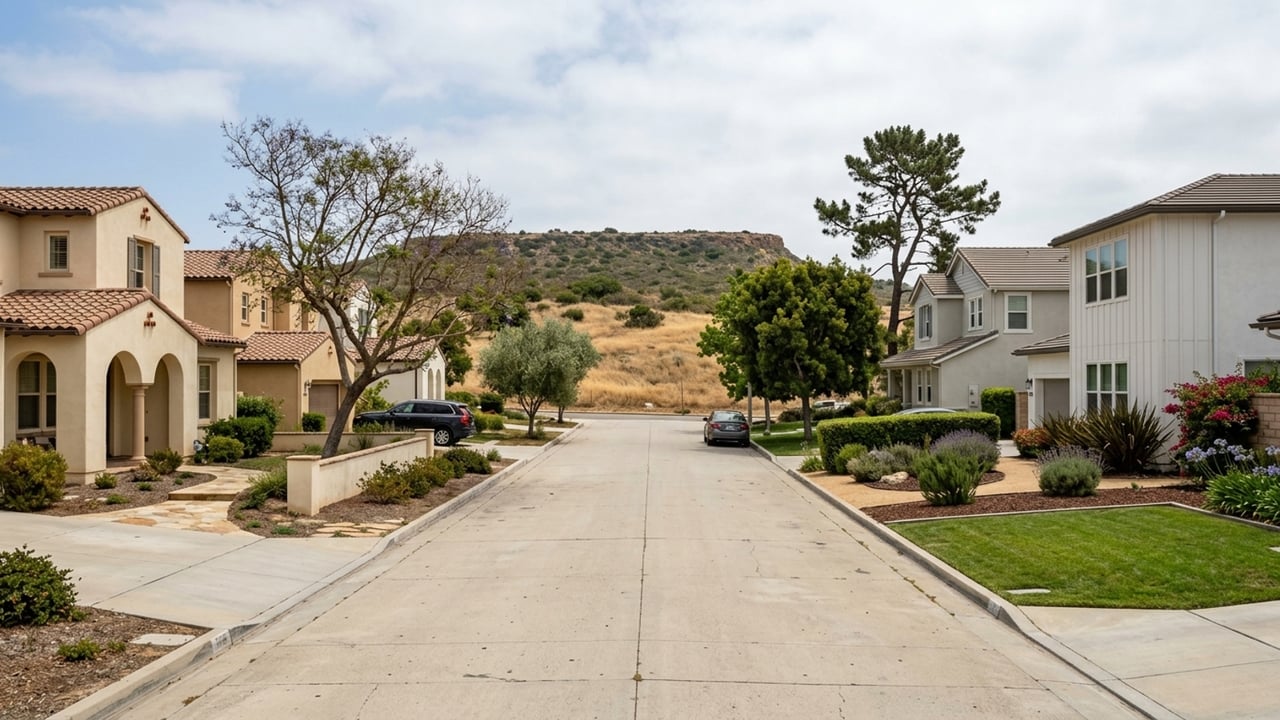
The median home price in Carmel Valley, CA is currently around $1.89 million, and properties spend an average of just 22 days on the market. Buyers competing for these homes often factor the local climate into their decision when evaluating the pros and cons of living in Carmel Valley, CA - and in this particular case, that's not just lifestyle preference. Located in San Diego County, the area offers a coastal environment that behaves quite differently from the inland neighborhoods many out-of-state buyers compare it to.
The area sits at an elevation of about 20 feet above sea level, which keeps it squarely under the influence of the Pacific Ocean. Understanding how that plays out month to month helps you plan for things like outdoor living spaces, landscaping water demands, and whether you'll need central air.
A Look at the Local Climate Zone
Carmel Valley falls within the broader San Diego climate zone, classified as a hot-summer Mediterranean climate - Köppen Csa, if you want the technical label. The coastal sections of the community also straddle the boundary of a semi-arid steppe climate.
What that means in practical terms: warm, dry summers and mild, slightly damp winters. Because the elevation is so close to sea level, ocean breezes moderate the temperatures in both directions - taking the edge off summer heat that punishes inland areas and keeping winter frost essentially off the table.
Season by Season Conditions
The transition between seasons here is subtle. You're not watching the leaves turn or scraping ice off a windshield - you're mostly noticing shifts in cloud cover and slight temperature changes from one month to the next. The Pacific Ocean sets the daily weather rhythm, and morning fog is a regular part of that. When it burns off changes depending on the time of year.
Spring and Summer
Spring brings a well-known Southern California weather pattern. The marine layer thickens, producing what locals call "May Gray" and "June Gloom" - heavy overcast mornings that typically clear by the afternoon. It can feel anticlimactic if you're expecting sunshine from the moment you wake up, but most residents get used to it quickly.
By July and August, the marine layer recedes earlier in the day. Summer high temperatures average in the upper 70s, and ocean breezes keep the air from feeling stagnant.
Fall and Winter
Fall is often the clearest stretch of the year. September matches August for the warmest average highs at 78°F, and October holds at around 77°F before things start to cool in November.
Winter stays mild. December and January see daytime highs around 67°F to 68°F, with overnight lows dipping into the upper 40s. This is also when most of the year's rain falls, so it's the wettest season - though "wettest" is relative out here.
Monthly Temperature and Precipitation Averages
The temperature range in Carmel Valley is narrow - the difference between the coldest winter days and the warmest summer afternoons is typically only about 10 to 15 degrees. That kind of consistency is one of the defining characteristics of this microclimate.
Precipitation is low, and the area depends on winter storms for the bulk of its annual moisture. If you're looking at a property with a large yard, factor those dry conditions into your landscaping plans before you fall in love with something that requires constant irrigation.
The Monthly Temperature Breakdown
Average temperatures for the 92130 ZIP code show a steady, mild pattern throughout the year. January and February both average highs of 68°F, with lows of 49°F and 51°F respectively. March warms slightly to a 69°F high and 54°F low.
April and May see highs around 70°F and lows between 56°F and 60°F. June reaches 72°F during the day and 62°F at night. The warmest stretch runs from July through October, with highs ranging from 76°F to 78°F and lows in the 60s. November cools to a 73°F high, and December drops back to a 67°F high and 49°F low.
Rainfall, Snow, and Humidity
Carmel Valley receives approximately 9.5 inches of rain per year. December is historically the wettest month, averaging about 2.2 inches of precipitation. Snowfall is essentially zero inches per year - same as the rest of coastal San Diego.
Annual average relative humidity sits around 72%. It drops slightly to about 69% to 70% in late winter and spring, then rises to roughly 74% to 76% during the summer months.
Local Weather Hazards and Environmental Factors
Southern California weather comes with specific environmental risks, and the main ones here are wildfires and Santa Ana winds. Dry vegetation and low annual rainfall create conditions where brush fires can start and spread quickly, particularly in the late summer and fall.
Santa Ana winds happen when high pressure over the Great Basin forces air downslope toward the coast. These winds are hot, dry, and fast - a combination that drops humidity and raises fire danger across San Diego County. If you're buying in this area, review local fire maps and verify insurance requirements before you're under contract, not after.
Timing Your Move to the Area
The local market moves fast regardless of season. With only about 1.8 months of supply currently available and 64 active listings, you're not shopping at a leisurely pace. Homes are selling for roughly 100% of their list price, and about 36% of recent sales closed above the asking price.
Since the weather is mild year-round, there's no real off-season for moving trucks or home inspections. Your timing should be driven by financial readiness and available inventory - not by waiting for the "right" time of year, because climatically speaking, they're all pretty similar.
Frequently Asked Questions
What is the weather like in Carmel Valley, California year round?
The area has a hot-summer Mediterranean climate with mild temperatures all year. Summer highs average in the upper 70s, while winter highs stay in the upper 60s.
Does it snow in Carmel Valley, California, and how much?
No. Carmel Valley averages zero inches of snowfall annually, consistent with the rest of coastal San Diego.
Is it humid in Carmel Valley, California?
The annual average relative humidity is about 72%. It ranges from 69% to 70% in late winter and spring, up to 74% to 76% in the summer.
What are winters like in Carmel Valley, California?
Mild, and the wettest part of the year. December and January see average highs around 67°F to 68°F and overnight lows in the upper 40s.
Are there tornadoes or severe weather in Carmel Valley, California?
Tornadoes aren't a typical hazard here. The primary severe weather risks are wildfires and hot, dry Santa Ana winds, particularly in the late summer and fall.
Does Carmel Valley, San Diego experience the coastal marine layer, like May Gray and June Gloom?
Yes. The area sits at an elevation of about 20 feet above sea level, which makes it susceptible to the marine layer. Overcast mornings that burn off by afternoon are common during the spring and early summer.
When is the best time of year to house hunt or move to Carmel Valley based on the weather?
Any month works - the climate is mild year-round. Base your timing on the market instead, where homes currently spend an average of just 22 days on the market.