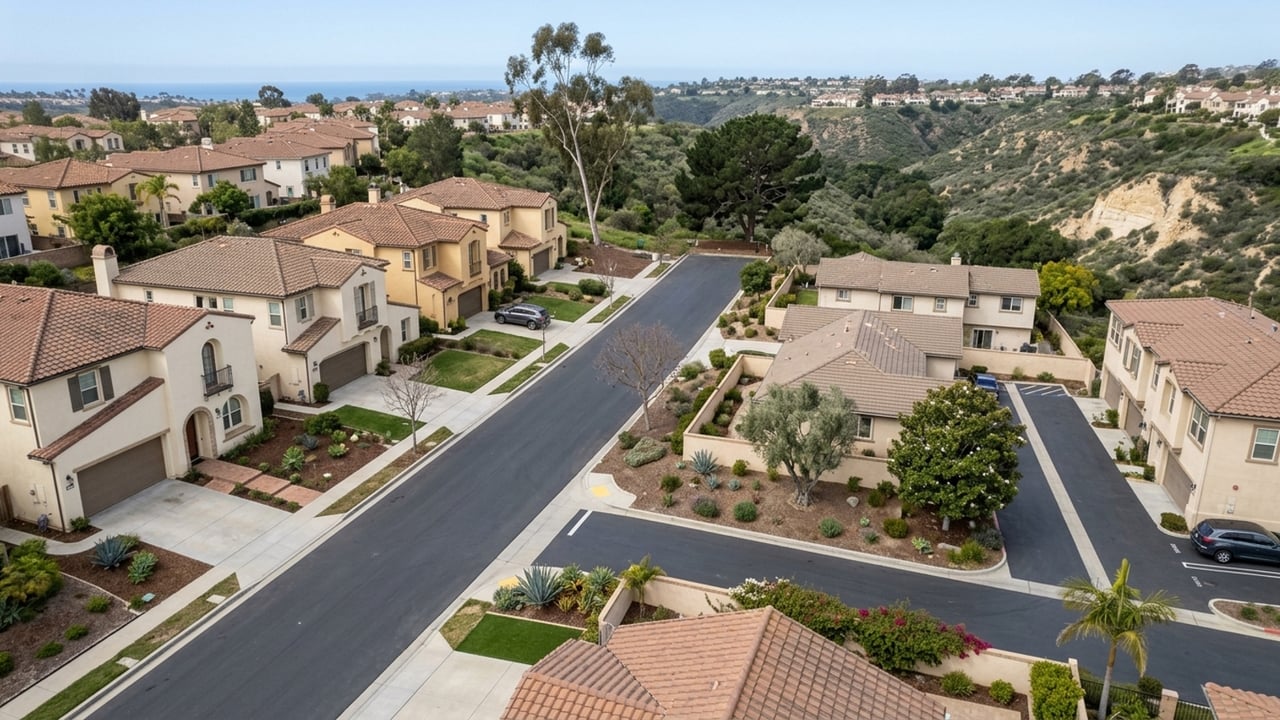
When you sell a home in Carmel Valley, San Diego, CA, the final price on the contract is rarely the amount that hits your bank account. Fees, taxes, and negotiated credits all come out of your proceeds before escrow closes.
Key Takeaway
Most Carmel Valley seller closing costs are rates applied to your sale price. That makes commission the line that moves your bill most, at tens of thousands of dollars per percentage point on a single-family home. Single-family sellers in the current tight market can usually refuse buyer credits, while condo sellers should budget for credits and HOA document fees on top.
Who This Guide Is For
You are preparing to sell a home in Carmel Valley, San Diego, and want to work out what will come out of your sale price at closing and what you will walk away with.
How Much Are Seller Closing Costs in Carmel Valley?
The documentary transfer tax, title insurance, and commission all scale directly with your final sale price. The controllable parts, like buyer credits, repair allowances, and carrying costs, depend on your negotiating position.
Right now, single-family sellers have around 1.1 months of supply, so they can usually say no to credit requests. Condo sellers face about 4.4 months of supply, so concession requests come up often. If you're also buying in Carmel Valley, your buyer closing costs follow the same county customs from the other side.
Which Costs Apply to Your Sale?
Are you selling a single-family home, or a condo or townhouse with an HOA? If there's an HOA, read HOA Transfer and Document Fees and your property type's profile under How Property Type Changes Your Closing Bill.
Do you still have a mortgage, a home equity line, a PACE assessment, or a solar loan on the property? If so, Mortgage Payoff, Liens and Reconveyance explains what escrow pays off and how timing affects the cost.
Is the home your primary residence, and are you a California resident? Your answers decide whether California Withholding and Disclosure Reports takes cash at closing. The capital gains FAQ covers the tax side.
Has a buyer asked for credits or repairs, or do you expect them? Buyer Credits and Concessions and Repairs, Inspections and Home Warranties show what each concession costs, and the condo example puts a number on it.
Costs Set by Law and Local Custom
Some line items are set by county tax rates or local practice. You can't negotiate a government tax rate or a title company's fee structure. You can only change who pays, and only if the buyer agrees.
Documentary Transfer Tax
San Diego County charges a documentary transfer tax on real estate sales. The rate is $0.55 per $500 of taxable value, which equals $1.10 per $1,000 of the sale price.
The City of San Diego has its own real property transfer tax ordinance. Its tax is combined with the county's rather than added on top, so Carmel Valley sellers pay the same total rate, split equally between the city and county.
The tax is charged on the full sale price. A buyer credit doesn't reduce it, while a price cut does.
Owner's Title Insurance and Escrow Fees
In San Diego County, local custom is for the seller to pay for the buyer's owner's title insurance policy, while the buyer pays for the lender's title policy. Escrow fees are customarily split 50/50 between buyer and seller. These are negotiable customs, not legal requirements. A buyer can ask you to cover their share of escrow, and in a slower condo market that request is more likely.
The title insurance premium is tiered by price, so it climbs steadily at Carmel Valley prices. Get a written quote from the title and escrow company for your expected sale price before listing.
Mortgage Payoff, Liens and Reconveyance
Escrow pays off every loan secured by the home, including your first mortgage, any HELOC, PACE assessments, and secured solar loans. It uses a payoff statement that includes interest through the exact payoff date.
Interest accrues daily until the loan is paid, so a delayed closing costs you money every day. A PACE assessment may also need to be cleared before a buyer's lender will fund the loan, so check your county tax bill for one.
You'll also pay a fee to the San Diego County Recorder to record the reconveyance: $17 for the first page and $3 for each additional page.
Property Tax and Mello-Roos Prorations
California property taxes are billed by fiscal year in two installments, due in November and February. Escrow credits the buyer for days you owned the home but have not paid, or refunds you for days you prepaid.
Many Carmel Valley tracts sit in Community Facilities Districts, and their Mello-Roos special tax is prorated the same way. Check your San Diego County tax bill for Mello-Roos or CFD special taxes. Closing just before an installment is due can leave a sizable debit on your statement, even though it covers only your share of the time owned.
HOA Transfer and Document Fees
Condo and townhouse sellers must provide the HOA's resale disclosure package to the buyer. California law gives the association 10 days from a written request to deliver these documents. It also lets the association charge the seller a reasonable fee based on the actual cost of preparation.
Some associations or management companies add transfer or rush fees on top. Ask yours for the current package fee, any transfer fee, and turnaround time before listing. You won't know the real cost until you request it, and rush fees apply if you wait until you're already in escrow.
California Withholding and Disclosure Reports
Escrow may withhold 3 1/3 percent of your sale price for the Franchise Tax Board unless an exemption applies, such as the home having last been your principal residence. Withholding isn't a fee, but if you don't claim an exemption you qualify for, that cash is held until you file taxes. Non-U.S. sellers face separate FIRPTA withholding, which can be 10% or 15% depending on the price and the buyer's use.
Sellers must also deliver a Natural Hazard Disclosure, usually from a third-party report the seller pays for. Get the report fee from the provider before ordering. Confirm with a tax professional whether you qualify for the FTB withholding exemption and how the federal home sale exclusion applies to you.
Costs You Can Negotiate
Commission, credits, and repairs are set by the contracts you sign, not by county ordinances or rate sheets. How much you concede depends on your bargaining power, and that varies by property type.
Listing and Buyer-Agent Commission
Commission is negotiable and is usually the largest seller line item. You set the listing side with your agent. Since the 2024 NAR settlement, buyer-agent pay is set in the buyer's own agreement and may be requested from the seller as a concession.
Refusing all buyer-agent compensation can resurface as a credit request in the offer, and in slower segments it can cost you offers entirely.
Buyer Credits and Concessions
A credit is cash off your proceeds toward the buyer's costs. The buyer's loan type caps how much a lender allows: up to 6% for FHA loans, with conventional limits varying by down payment.
A credit costs you its full amount. A price cut of the same size costs a little less, because transfer tax and commission shrink with the price. However, a price cut lowers the recorded sale price that future comps use, while a credit leaves that price intact.
Repairs, Inspections and Home Warranties
Inspection findings often turn into repair requests or credits. At sale, California requires an operable smoke detector and a water heater secured against earthquake movement. It also requires carbon monoxide devices in homes with fuel-burning appliances, fireplaces, or attached garages.
Home warranties and pest-report repairs are negotiated, not mandatory. Get repair bids before agreeing to a credit amount so you don't overpay for a fix. Repairs can also push back your closing date, and every extra day adds interest and carrying costs.
How Property Type Changes Your Closing Bill
Single-family homes, townhouses, and condos each attract different buyer pools with different financing needs. Each type's recent sales pace shows whether you should expect credit requests and carrying costs.
Selling a Single-Family Home
Single-family homes carry the largest dollar fees but the strongest seller position. Nearly one in three Carmel Valley single-family homes sold above asking in the latest 90 days.
Competing offers let sellers decline credits, limit repair asks, and choose title and escrow terms. Your effort goes into commission and timing, not into buyer concessions.
The catch is that every fee is a percentage of a seven-figure price, so small rate differences in commission or title become large dollar amounts. A late closing also costs more each day on a large payoff.
Selling a Condo
Condos have the smallest fee totals but the least bargaining power. They recently sold at 97.8% of list price, which tells you buyers are negotiating.
Budget for a credit. If FHA or VA buyers matter for your condo, check your complex's FHA approval status.
The catch: on a condo, one credit can cost as much as a full commission point, and HOA document and transfer fees come on top of everything a single-family seller already pays.
Selling a Townhouse
Townhouses fall between the other two on price and negotiating power, but they sit on the market longest: 53 median days on market. That figure rests on only 16 sales, so your complex could move faster or slower.
That's nearly two months of mortgage, HOA dues, taxes, and insurance while listed. It's a real cost of selling, even though it never appears on the settlement statement. Total your monthly carrying costs before you set a price, and expect HOA resale fees here too.
Estimate Your Net Proceeds: From Sale Price to Net
Substitute your own expected price in the steps below. Your final numbers depend on your loan payoff and the quotes you receive from escrow.
Single-Family Example at the Median
Start from the $2,607,621 single-family median and subtract the county transfer tax, about $2,868.
Next, subtract commission at about $26,076 per 1% of price agreed upon. Then deduct your title and escrow quote, the loan payoff, and prorations. Leaving out a buyer credit is realistic here.
The example leaves out capital gains tax and any FTB withholding. Your real net comes only from escrow's estimated settlement statement.
Condo Example at the Median
Start from the $749,888 condo median, which rests on a small sample, so treat it as directional. Apply the transfer tax, roughly $824, and commission at about $7,499 per percentage point.
Add HOA resale and transfer fees from your HOA quote. A one-point buyer credit takes the same amount again as a full point of commission.
How to Lower Seller Closing Costs
You can't change county tax rates or recording fees. You can control the negotiated line items that take the most from your proceeds. If you're weighing a cash offer, selling for cash changes which costs apply to your side of the ledger.
Negotiate Commission Before You Sign
Agree on commission before signing the listing agreement, including how any buyer-agent compensation request will be handled. The lowest commission doesn't guarantee the highest net if pricing, marketing, or negotiation suffer because of it.
Price So You Don't Have to Give Credits
Accurate pricing reduces credit and repair concessions later, especially for condos and townhouses, where buyers hold more negotiating power. Align your price with recent comparable sales and current housing market conditions. Pricing too low to avoid concessions can cost more than the credit would have.
Request Payoff, HOA and Tax Documents Early
Order the payoff statements, HOA resale package, and NHD report before listing to avoid rush fees and the daily interest of a delayed closing. Confirm how long each document stays valid. Documents can expire before closing, and some HOAs charge again for updates.
At a Glance
- Single-family median sale price: $2,607,621, with a median of $878 per square foot and +15.1% year over year (47 sales, 90 days ending 2026-10-31)
- Single-family pace: 26 median days on market, 99% sale-to-list, 30.3% sold above list, 1.1 months of supply, 17 homes in inventory (90 days ending 2026-10-31)
- Townhouse median sale price: $1,249,963, with a median of $828 per square foot and -1.2% year over year (based on 16 townhouse sales, 90 days ending 2026-10-31; small sample, treat as directional)
- Townhouse pace: 53 median days on market, 98.5% sale-to-list, 19.8% sold above list, 2.9 months of supply, 15 homes in inventory (based on 16 townhouse sales, 90 days ending 2026-10-31)
- Condo median sale price: $749,888, with a median of $794 per square foot and -2.6% year over year (based on 18 condo sales, 90 days ending 2026-10-31; small sample, treat as directional)
- Condo pace: 44 median days on market, 97.8% sale-to-list, 5.8% sold above list, 4.4 months of supply, 25 homes in inventory (based on 18 condo sales, 90 days ending 2026-10-31)
- All homes: $2,093,998 median sale price, 81 sales, 42 median days on market, 98.7% sale-to-list, 22.7% sold above list, 2.2 months of supply, $835 median per square foot (90 days ending 2026-10-31)
Carmel Valley Seller Closing Costs FAQs
Who Pays Most of the Closing Costs in San Diego County?
The seller usually pays the larger dollar share, because commission, the county transfer tax, and the buyer's owner's title insurance policy fall on the seller by custom. Ask escrow for a net sheet to see your specific total.
Can a Seller Refuse to Pay Closing Costs in Carmel Valley?
Yes. What you owe is set by the purchase agreement, not by law, so you can decline credit requests or the buyer's customary share of costs. The buyer's loan type also caps how much credit is allowed.
Is 3% Normal for Seller Closing Costs in Carmel Valley?
It depends on whether commission is included. The fixed county items, including the transfer tax, are a small fraction of the price, while negotiated commission usually pushes the seller's total well past 3%.
Is $20,000 in Seller Closing Costs a Lot in Carmel Valley?
Excluding commission, $20,000 is less than one percentage point at single-family prices but a larger share on a condo. Compare it with the per-point math in the net proceeds example to see how much of your equity it represents.
What Are Seller Closing Costs on a $1,000,000 Home in Carmel Valley?
At that price, the transfer tax is about $1,100, and each point of commission or credit is $10,000. Title and escrow fees come from a quote.
When Does the Seller Pay Closing Costs in California?
Seller costs are deducted from the sale proceeds at the close of escrow and itemized on the final settlement statement. You write no check unless proceeds don't cover the loan payoffs. Escrow also sends any FTB withholding at closing, so ask for the estimated statement before signing.
Do Sellers Pay Capital Gains Tax at Closing in California?
No. Capital gains tax is settled when you file your tax return, not at closing, although FTB withholding may apply. Under federal rules, you may exclude up to $250,000 of gain, or $500,000 for certain joint returns. To qualify, you must have owned and used the home as your principal residence for at least 2 of the 5 years before the sale.
Do I Still Pay Closing Costs If a Cash Buyer Purchases My Carmel Valley Home?
Yes. The transfer tax, commission as agreed, title and escrow by custom, payoffs, and prorations all remain. What disappears is the buyer's lender costs and any lender cap on credits, and a faster close can cut daily payoff interest.
Sources
- Redfin: Data Center
- California Legislative Information: RTC 11911
- City of San Diego Municipal Code
- JVM Lending: Title Insurance Costs
- Deeds.com: San Diego Recording Fees
- San Diego County Treasurer-Tax Collector
- California Legislative Information: AB 2430
- California Legislative Information: RTC 18662
- US Code: IRC 1445
- California Legislative Information: CIV 1103.4
- California Legislative Information: HSC 13113.8
- Fannie Mae: Selling Guide
- HUD Answers: Seller Contributions
- US Code: IRC 121